Showing posts with label Economics. Show all posts

Wednesday, December 3, 2014

Whither PLEX?

Here is a graph of recent PLEX prices, courtesy of eve-marketdata.com.  Note the long and relatively smooth ride up, then the peak indicated by the red dot, which was Nov. 19.  Then there is a small correction, with two other near-peaks on Nov 21 and Nov 24.  Then a steep decline, to where we are now.  Not enough data to say yet where it will go.  But we can analyze, and we need to decide whether to buy.  Thus, this article.
PLEX prices, past three months.
Price, as we know from microeconomics, is set by supply and demand.  Let's look at the market for PLEX.

There are several factors that I think are affecting the PLEX supply.  They are, in order of timing, the influx of "This-is-EVE" newbs, the ISBoxer policy change, and the Thanksgiving weekend PLEX sale.

"This is EVE" effect on new accounts.
The first factor is a bunch of newbs coming into the game.  Ordinarily EVE gets ~2000 new accounts per day; these include people trying the game out for the first time as well as old players creating new alts.  After the smashing success of the "This is EVE" video, which was released Nov 21, newbies flooded into the game  New account creation hit something like 8000 per day, briefly.  This has dropped back a lot, but the rate is still about 50% above normal, something like 3000 new accounts per day as I write.  I would guess that a high percentage of these accounts are new players, not just new alts.

(The image is from eve-offline.net.)

Some of these newbies are going to find out about PLEX and want to use one or two to kickstart their career.  Others (and I have spoken to two, now, out of perhaps several hundred newbies in the rookie channel whose questions I have answered) are going to want to jump right past the whole low-skill part of being a newbie, and drop a bundle to buy a skilled character.  For that they need two PLEX, plus a boatload of ISK.  So there is at least some additional demand.

Demand for PLEX can be supplied in two ways.  One is by spending ISK in the in-game market; the other is spending IRL money.  Obviously, few of these newbies are going to be able to PLEX with ISK for some time now.  They have low skills, as a character and a player.  So, we expect them to buy PLEX with IRL money and drop them into the game.  This will tend to depress prices.

Probably the main factor is the recent change in ISBoxer policy.  For some time now, ISBoxer has been tolerated by CCP.  Last week (Nov 25), CCP Falcon announced a change: no input multiplexing to anything in-game.  So, you can still use ISBoxer to log in many accounts, or to organize your windows.  But you cannot send input of any kind (i.e. mouse moves, keypresses) which affects the game to multiple clients.  This change takes effect on January 1.

Immediately upon this announcement, PLEX prices took a steep hit.  (Possibly slightly preceding it?)  This is the sharp downward move after the last peak is hit.  Obviously, people believe that because multiboxers almost exclusive PLEX their accounts (nobody pays IRL money for 20 accounts just to mine more ice), their demise will free up so much PLEX that it will significantly lower demand.

There is debate over how much of an effect the multiplexing ban will have.  Some say not much at all.  But in any case, since the ban is not even in effect yet, the reduced demand for PLEX that will happen on January 1 should have minimal effect.  Yes, there will be some reduced buying, for people that happen to PLEX their multiboxed accounts for months in advance.  And starting Dec 1 (well after the price dropped), there should be some multiboxing accounts that are starting to expire and are not being renewed.  But this effect should be minimal.

The stronger effect must be speculation.  I think that the PLEX selling is less a direct effect of the ban than indirect: because people believe it will reduce multiboxed mining a lot, they believe it will reduce PLEX demand.  As such, people think PLEX will drop, and then sell because of that -- a classic example of efficient markets pricing in all information immediately.

The final supply factor is the PLEX sale that happened starting on Friday, Nov 26.  This sale went on through the weekend.  PLEX sales don't usually tend to affect the price that much, but they do often have a small downward effect on prices.

Meanwhile, what about the demand side?

Well, there are evidently a lot of people like me.  I prefer to safeguard value in PLEX, not ISK.  As I have written: PLEX is money because it retains value much better than ISK.  As such, everyone should try to preserve value in PLEX.  And this is, evidently, what a substantial number of players do.

(There is a very interesting comment I saw by "Baki Yuku" at TheMittani, on this article about the input replication policy change:
PLEX price is where it is because people are using it as an invetment tool on a massive scale. According to CCP (last fanfest) only 45% of all PLEX injected into the market every month is being consumed. That means 65% are being brought as an investment.
Obviously it is hearsay and the math does not exactly add up.  But it does confirm my suspicion that a lot of PLEX is being used as money.)

I've been sitting on a pile of ISK for some time now, both my personal savings and my corporate savings.  However, because PLEX have been so expensive, I've been waiting for a correction.  Now PLEX drops, and there is a golden opportunity to buy.  I bought.  I think a bunch of people have.  So, collectively the demand to preserve value is sucking up excess supply.

There is one more modest factor on the demand side.  In Rhea, CCP is going to abolish clone grades.  Upgrading clones is an ISK-sink; it is about 3% of sunk ISK according the only data I am aware of on the subject.  Clone costs are basically going to go away entirely.  (CCP will raise the amount required to re-home your clone, but it is still quite cheap, and how often do people do that?)   Other things being equal, this move will marginally decrease the ability of ISK to safeguard wealth.  So PLEX win a bit here.

Summary: I think PLEX is a good buy.  All the fundamentals are there, other than possibly some decline in multiboxer demand.  But I think there is plenty of demand in New Eden for secure savings, that will offset that decline.

As previously mentioned, I have been buying PLEX for my corp and myself throughout the recent decline.  I got some at 900m, a few as low as 812m, and most around 830m.  If the price drops further, I may buy a few more, but I am mostly content with my ISK/PLEX balance.  We'll see if my purchases were wise or not.

Wednesday, October 8, 2014

Anomalous Prices

CCP is running a contest that may be of some interest to wspace residents.  It is detailed in a recent dev blog titled Anomalous Materials: The Research Race of YC 116.  The key parts:
The empire navies are requesting donations of Neural Network Analyzers and Sleeper Data Libraries to help them [technobabble]. 
... this storyline and the associated donation drive will lead directly to new technology falling into the hands of players in the near future. The relative success of each empire’s donation drive will determine in what order each faction will get access to this new technology. 
Each faction navy will also express their gratitude through a special ingame item representing an honorary commission to their forces. The commissions will be given to the character that donates the highest value of Neural Network Analyzers and Sleeper Data Libraries (combined and weighted) to each faction over the course of the event.
This event is open now, and will run until downtime on Tuesday, October 14th.
So, two things of interest here.  First, until next Tuesday, Neural Network Analyzers (NNAs) and Sleeper Data Libraries (SDLs) should sell at a premium.  Ordinarily NNAs sell to NPC buy orders for 50000 ISK.  SDLs sell for 200000 ISK.  There is no reason to take less, and (blue loot being useless otherwise) no reason for anyone to offer more.  The NPC price, of course, won't change.  But the prices at market hubs will rise.

How far will prices rise?  This we cannot know.  Since the only real reason to contribute to this drive is vanity, we can imagine not that much.  On the other hand, there are a lot of players with so much wealth in ISK that they have nothing to buy with it.  If one of them decides he wishes to win this contest, the price can rise almost arbitrarily.  The supply of blue loot is only a little bit elastic.

As I write this, NNAs are selling at Jita between 115000 (high buy) and 190000 (low sell) ISK.  SDAs are selling between 300000 (high buy) to 549000 (low sell) ISK.  (We expect the two prices to stay at a ratio of 1:4, which they are very roughly.)  As one expects, the low-priced supply of these items outside of trade hubs has been completely sucked up.  I expect the prices to rise, since there was a supply of old sell orders through this morning.  From here on out, all supply must come out of stockpiles or fresh from wspace.

So, this is the time to make some extra profit.  If you are planning to sell blue loot, don't take the NNAs and SDLs to an NPC station.  Take them to a hub and profit.

A related way in which this may be good for wspace people is that there are going to be a lot of extra players in wspace this week, looking to make a bit extra from blue loot.  Newbs in lower wspace ratting solo or in small gangs?  You know what to do.

The other item of interest here is that "new technology".  Presumably CCP is planning to add some new stuff to the game.  If lore-wise a tech is a result of blue loot, there is a good chance it will be T3, or more broadly it will be something requiring inputs from wspace.  So, this may represent new wealth for us in the moderately near future.

Monday, September 29, 2014

Slow Times in Wspace High

These are slow times in wormhole space for this hunter.  I have been beating the bushes like crazy, but no birds have appeared. 

The new thing is that wspace is now hyper-connected.  Previous to Hyperion, a lot of our chains would look like this: C4a->C4b->C3a->ns.  Maybe a few side systems, but usually not enough to go on forever.  Then termination in known space.

With Hyperion, There are more connections everywhere, and every C4 system now gets two at least.  I routinely get more systems than I am willing to scan to.  My trees look like this:
Screenie from Tripwire
That is after only a partial night of (fruitless) searching.  I went down my K162s and into my H900, but I did not search it nor did I yet enter my X877.  In all those systems I saw probes once, and one Venture out in space that left and did not return before I could kill it.  (I might have spooked it somehow; don't know.)

Mathematically, when you increase the average connectivity of a graph from ~1 connection per node towards two, the size of connected chunks increases exponentially.  This is what has happened in wspace.  I expect that if all connections were instantiated, almost all of wspace would be in one large connected chunk.. There would still islands here and there, and of course a lot of the time connectivity is lowered because nobody is activating wormholes.  Still, from the POV of a hunter, the connectivity means you rarely have to leave wspace to find a new chain. 

The bad news?  First, I can't find anyone.  Anecdotal, but suggestive.  I see probes now and again, but I feel like the activity level of people running sites is down.  Usually I find a couple site runners per week. 

Another bit of suggestive anecdotal data is the rate at which new sites spawn.  Presumably, the set of sites in wspace is fixed and they are just kicked around from system to system when they either despace after being triggered, or despawn from being run.  I am very sensitive to the spawn rates of new anoms in my system.  Since Hyperion, the rate is about half what it used to be.  Formerly we'd get about 1 new combat anom or sig per day.  Now it is one per two days. 

I looked at prices of various wspace products, but there's no obvious trend I see.  I think it is too soon.  But I expect to see them rising.

Friday, September 12, 2014

EVE and RMT

There's a new blog banter out, #58 - Money:
The SOMERBlink fiasco from last summer and then again this summer... resulting in the service's ultimate shutdown has opened the floor to the discussion or monetization of services once again. 
Do you think CCP was right in its reaction? Was SOMERBlink justified in trying to monetize its service via plex sales kickbacks? Was it true RMT or grey area RMT? 
More generally, where is the line to be drawn when a service attempts to monetize in order to offset costs and/or make a profit? Is asking for donations in Real Life cash too far (I realize CCP considers it unacceptable right now)? Selling non-EVE trademarked goods acceptable? Asking for money to pay for efforts in setting up EVE meetups? Should these all be scrutinized? 
And should you want to dig deeper, should players be allowed to reverse redeem plex for cash? Does this already not exist in programs like Plex for fanfest packages or video cards? Is it right?
About Somer

First off, I am not that interested in Somer.  What they did was RMT, but the RMT per se was not the heart of what they did wrong.  RMT is fine if done with CCP's blessing.  (I.e., PLEX, fanfest packages, video cards, etc.)  Somer did not have CCP's full and knowledgeable permission to do RMT.  They tricked CCP into a sort-of permission to do it, and that is a very different thing.  It's one thing to trick someone with inferior or equal power; you can sometimes get away with it.  It's another thing to trick the hand that feeds you.  It was a stupid ploy.  Then they compounded their error by breaking EULA in several ways.  CCP did the right thing.  Nobody wants a subordinate that tries to scam and refuses to accept the rules.

Why or Why Not RMT?

Now let's talk in more generality.  Why is RMT banned, anyway?  Presumably, because its downsides outweigh its upsides.  But what are the upsides?  You don't hear people talk about that very much.  Let's look at both sides.

Why RMT?

There's a very interesting scifi element in Neal Stephenson's recent scifi novel Reamde (sic).  In the book's near-future world there is a MMO called "T'rain", which features full RMT, by design.  Indeed, the RMT is said to be among the reasons why the game is such a fictional success.  Legions of third-world gold farmers make a living by playing T'rain.  They are the low-level farmers (literally) in the game; it's their real-life full time job.  Rich Westerners play the game as a game, paying subscriptions, and are in effect the aristocrats of the game.  Each one has a horde of farmers working beneath him.

T'rain aristocrats are paying for three things that are affected by RMT: a living world, dominance, and status.  Let's look at each of these, and see how it is related to RMT.

First, T'rain is a living fantasy world that is full of actual people, not just simulated people.  (It also has a lot of computer-controlled baddies for PVE purposes.)  All the scutwork -- mining, farming, woodcutting, etc. -- is being done by characters in the game.  Everything is simulated down to the geology of the virtual world.  So, the world feels real.  Think about the difference in feel between an ice anomaly, and a level four mission.  In both, the grid is full of ships.

Second, just as in EVE, the T'rain aristocrats are the guys who get to run around and have adventures, many of which include fighting each other.  When you fight, someone wins, and gets the thrill of dominating another real human being.  Compare PVP in EVE to PVE.  The same thing applies: killing people is thrilling.  Losing is crushing, but for most people it does not depress you as much as a win elates you.  So, you ride the rollercoaster.  And note that in T'rain, there are "peasants" -- the gold farmers -- who presumably players can kill if they want a cheap win.

Similarly, presumably in T'rain if you want to hurt someone you can go and kill his peasants, Game of Thrones style.  Think of the difference in EVE between ganking and PVE.  In both you are shooting ships which in effect cannot win.  But ganking is typically fun; real tears are generated.  Compare the staid predictability of PVE.  Dominating a computer-played static fleet -- a fleet which is designed to allow you to beat it -- ceases to be fun after a while.

Third, the T'rain aristocrats get the thrill of being actually high-status in the game.  Human beings crave status perhaps as much anything else; they'll sacrifice a lot for it: money, sex, their very lives, even the lives of their children.  It's a very powerful motivator.  In most games the player is high status in the game's asserted fiction; for example, he's a "Jedi knight" and everyone knows that "Jedi knights" are high status supermen.  But the player in most games does not in fact have actual status in the sense of having actual human subordinates.  At best he has NPC subordinates; and after a point they do not tweak our status circuits.  By contrast, in T'rain, you could pay for actual status -- that is, having human subordinates -- and get it.

So, in summary, T'rain hits on a lot of the same buttons that EVE does.  But it does some things arguably better: a better simulated world, and higher status for its paying players.  Of course, we should keep in mind that T'rain is fictional.  I think the elements above would be successful in a real-world game.  Some of them are in EVE!  But it's trivial to assert in a story that your game is a worldwide smash hit because of X.  It's another thing to write an actual popular game, and yet another that a real game is popular because of X.

So, there are reasons why CCP should forget about monopolizing RMT and let people do it.

So why not allow RMT?

Why Not RMT?

Of course, CCP does allow very generous RMT: that's what PLEX is.  (Ref: my old post on EVE's Amazing AIs.)  But PLEX is uni-directional: money goes in; it never comes out.  What about opening up the other direction?  Of course, CCP should profit from it.  They might set up a online currency exchange: a modest "tax" on exchanges of say 10% seems like it should extract a lot of profit from the practice while still being low enough that black-market RMT is minimized.

One huge reason why full RMT might be a bad idea is real world laws.  If you hold someone's money for them, you are a bank, at least arguably.  And therefore arguably banking regulations should be applied to you.  I have certainly seen this mentioned in the RMT context.  I don't know how applicable it really is.  But if it is, I can certainly see that allowing any RMT might be prohibitive costly.  But let's ignore this reason for now and concentrate only on reasons related to game design.

One reason why people think that RMT is bad is that it makes it hard to earn ISK.  I discuss this with Gevlon in the comments of this post.  I make the point that ISK incomes would not collapse totally; they'd just drift down towards the global minimum wage.  (Really the minimum wage that obtains in places which have good internet access and sufficient population.  Today that is probably China.)  At the time, I computed 14m ISK/hour as that level; that was with PLEX around 500m.  The rate today would be somewhat higher, more like 20m ISK/hour.  This may not seem great to a wspace or null person.  But there are many people today earning less than that in highsec.  Highsec's safety counts for a lot, for many players.  So, there is definitely a viable game left even after all higher-profit work is professionalized.

Now, it should be apparent that in opening a competition between people all over the world to "play" EVE as a job, you open up competition and will drive wages down, at least somewhat.  A Chinese peasant may compare a job mining veldspar in EVE to, perhaps, working as a street-sweeper, and decide that he can survive on less than minimum wage.  The work is much more pleasant.  So wages would probably be a bit lower.  Still, the estimate is fine on that end.

Another thing that would happen with full RMT is that PLEX would go up quite a bit.  Consider a Chinese peasant playing EVE to make money.  He finds that they can rat in nullsec for 60m ISK/hour.  So he and a friend get an account and rat with it all day in shifts, perhaps 20 hours per day, six days per week.  Over a month, that's 33.6b ISK.  From that, they need to buy one PLEX to run the account; PLEX cashed out beyond that earn them minimum wage.  But their mininum wage is on the order of $112/month; if they can cash out a PLEX for $15 legally, then they'd need 15 of them to pay just over minimum.  16 total.  So we see a valuation of 2.1b ISK/PLEX.  (Perhaps not coincidentally, PLEX are just about 2b ISK on the Chinese server, although they pay about half as much for PLEX.)

So what's the problem here?  The problem is that everyone becomes risk averse.  That is because everyone has the possibility to extract real cash from the game.

Now, there's no problem in farmers becoming, or rather being, risk averse.  The Code to the contrary, pure farming is a viable play style.  And farmers already are famously risk averse.  They'd be perhaps bit more so with the ability to cash out, but really not that much.

It's the rest of the players that would have their incentives changed much for the worse.  Currently, it is relatively easy to earn more than PLEX.  So people pile up ISK with nothing to do with it.  For those whom ISK is not an end, but a means to more pixel violence, lots of ISK will eventually mean they fly more, or they end up up-shipping, flying more expensive ships.  They are more capable and also more fun to blow up.  Thus, everyone benefits.  And people stay in the game, because the spaceship violence is compelling.

Consider an EVE in which losing a "$1000" Titan really is losing $1000... and suddenly, you won't see many Titan pilots.

By making the accumulation of ISK easy, and having nothing to spend it on but spaceship violence, CCP induces lots of spaceship violence in their game of spaceship violence.  And that's a good thing, because lacking spaceship violence nobody would play EVE.

But What About PLEX-for-Vidcards?

So, the point of disallowing cash-out-RMT is to make sure EVE stays fun, which is what happens when there's nothing better to do with ISK.  But what about all those methods of trading PLEX for real stuff mentioned in the banter?  Video cards and fanfest packages, etc.?

Well, those do give players an outlet for ISK, and so they should have the effect of reducing the amount of pixel violence going on.  But on the other hand, at least arguably by handing out things related to EVE, you cement fan loyalty directly, and keep them playing because they like the game more.  So, I think it's a wash on the "fun" factor.  And also, it's a clear win to the extent that many of the people using these offers are not PVPers.  They're not going to do anything with the ISK in any case.

There is also the point about professionalization.  By allowing cashout in any form, CCP reduces the amount players can earn in game, because people will do extra farming to earn ISK for cashout.  But so long as CCP keeps the amount of cashout relatively small and unpredictable, this is not a real problem.  "Relatively small" here is relative to the global minimum wage.  Allowing cashout of a PLEX per month is insufficient for anyone to live on.  Unpredictable just means that you cannot come to rely on that income.  Also, cash per se should not available; rather, goods or services, ideally services that are not salable.  This makes it more difficult to live on cashout opportunities.

Tuesday, July 15, 2014

Investments

Hint, hint.
Seen the launcher recently?  CCP is making a point to tell you: PLEX prices are through the roof.

And yeah, I called that.  (Gloat.)  PLEX is money; more specifically, PLEX is the best commodity in New Eden to store value with.  Gevlon asserts it.  Croda at marketsforisk is another investor seeing the same thing.

PLEX is money, and it's winning over ISK for the fundamental purpose of preserving value.  Can PLEX go higher?  Yes, we know they can; on the Chinese server PLEX sell for 2 billion ISK.  There's a lot of upside here.  Can they go lower?  Of course.  But the path to lower starts with ISK being able to better preserve value.  Is CCP doing anything about that?  Nothing large.  Manufacturing costs are set to rise in Crius, but it seems unlikely that they will rise anywhere near the level of the ISK faucets pouring ISK into the economy.  And not only that, but if manufacturing costs do become a large ISK-sink, to a large degree it won't matter, since most of those costs will be passed on to customers.  Customers who, for the most part, are getting ISK from faucets via grinding.  They'll grind a bit harder, opening the faucets wider, offsetting the gain in ISK moneyworthiness that would otherwise happen.

That's why I rated PLEX as a strong buy back in May, and I did indeed buy a stack of them when the next sale happened.  I got in at around 670m in the PLEX sale that accompanied the release of Cronos.  (Indeed, it would have been superior to simply buy as soon as I posted that article.)  So I have 20 PLEX backing up my position that PLEX are better money than ISK.  (I have some older ones which I guess should also count.)

Another investment I am dabbling in is Geckos.  Geckos have an absolutely restricted supply -- no new ones can be created in game.  Geckos are highly useful, doing much more damage than equivalent heavy drones, with the speed and tracking of medium drones.  And yet as drones, they are going to get lost from time to time, both by being blown up aboard PVP ships, and accidentally left behind in missions.  Also, new missioners and PVPers will find fits that use them.  As such, they seem like a great investment.  So I bought about a billion ISK worth.  When I did it, they were at 18m ISK, then they dropped.  They have mostly recovered.  Small loss, but I expect a long term gain. 

There's one big problem with the idea of investing in Geckos: CCP can ruin the investment at any moment by adding new Geckos to the game.  Small quantities of Geckos seem probable (i.e, Christmas), but the market can absorb them in time so long as they are finite.  Whether or not CCP adds Geckos into the game in some in-game form is the real question.  Right now I am betting "no".

I think Geckos will be a good investment in the long run, but (unlike PLEX) don't bet your portfolio on it.  Just a fraction.

Wednesday, May 28, 2014

PLEX is Money

The formidable mynnna, a guy who knows a bit about economics, has an article up at TMC entitled The Great PLEX Bubble.  As you can tell from the title, his argument is that PLEX are a bubble.
Given the context [a fact-filled discussion of the supply and demand for PLEX], the conclusion is obvious: people buying PLEX off the market are tending to hoard them, rather than use or resell them.
I'll repeat here what I wrote there, since it is buried there anyway, and expand a bit.  My thesis is as follows: PLEX are in a bubble, but that does not mean what most people think it means, namely that PLEX will eventually "pop".  The PLEX bubble won't pop because PLEX are being used as money.  Money is a bubble that does not pop.  Due to peculiarities of its design, EVE has two forms of money, splitting the normal functions of money in two.

I.  About Money

What is money, and what are its functions?  You can look at the definition at wiki for some insight:
Money is any object or verifiable record that is generally accepted as payment for goods and services and repayment of debts in a particular country or socio-economic context. The main functions of money are distinguished as: a medium of exchange; a unit of account; a store of value; and, occasionally in the past, a standard of deferred payment. Any kind of object or verifiable record that fulfills these functions can be considered money. 
Money is historically an emergent market phenomenon establishing a commodity money, but nearly all contemporary money systems are based on fiat money. Fiat money, like any check or note of debt, is without intrinsic use value as a physical commodity.
ISK is a fiat money, the ultimate fiat in a sense.  It does not need a "legal tender" clause.  It is implemented in software; within New Eden, ISK-as-money is a physical law.  Now consider the functions of money.  Certainly ISK is the medium of exchange in New Eden, and its unit of account.  ISK do store value.  So, ISK have definite monetary qualities there.  However, ISK are relatively poor as a store of value.

II.  The ISK Economy

Why are ISK a poor store of value?  It does not matter why, for the purposes of my argument; only that it is.  You can skip this section if you want.  However, it's worth understanding anyway.

ISK are a poor store of value because they are being created much faster than they are destroyed.  (Two step computed the rate of ISK dilution in 2012 as 1 trillion ISK per day entering the economy.)  Note that I avoid the word "inflation" because it has been coopted in modern times to mean a measured rise in "general" price level, whatever that is exactly.  It's inherently ill-defined and thus subject to endless debate.  Dilution is a precise concept: there are more ISK in existence.  This is a measurable thing and, for ISK, a confirmed fact.

Players can create as much ISK as they like, simply by ratting in null, or farming sleepers for blue loot, which is then sold to NPC buy orders.  Both of these are massive faucets.  (Incursions are also apparently a pretty big faucet, though I don't know exactly how.)  There are also many sinks, but the sinks are mostly one-off things (skillbooks, BPCs) or related to production; they are inherently limited.  And of course they are also disincentives for behavior; you can't farm a sink.

What is the purpose of this ISK dilution?  It is to subsidize the faucet regions (null and wspace) at the expense of the sink region (highsec).  Without the huge faucet of rat bounties, null would be an abandoned wasteland.  Similarly, wspace would be a lot more abandoned without blue loot.  Killing sleepers does have a use-valuable product (sleeper salvage, particularly nanoribbons), and so there would be some chance for market forces to help keep it viable.  But the same is not true of null: little resource extraction or production happens there.  (I hope this changes with Crius.)  And yet those huge fleet battles are priceless publicity for EVE, and the fascinating metagame with comrades keeps people subbing.  Thus, ISK subsidy.

III.  ISK and PLEX Contend

Returning to the main argument, we observe empirically that ISK is anything but a reliable store of value.  Thus, there is an opening for a second form of money.  This will be whatever commodity is found to be best at holding value; it must be in limited supply and very hard to produce, if producible at all.  In addition it should be highly liquid.  You guessed it: in EVE that commodity is PLEX.  PLEX is superb as money in this important respect.  Not ideal -- the ideal money cannot be created; obviously players can create PLEX.  But PLEX creation is sharply limited by real-world economic constraints, namely, that PLEX cost real money.  And also it is balanced by the constant removal of PLEX via use.  As such, it is not a serious problem.

Now, what happens when you have two currencies in contest?  Generally, one will out-compete the other and dominate it utterly; the loser fades away.  The reasoning here is a bit subtle, and I refer you to this excellent and provocative long-form piece on it.  Put short: because money is necessarily more valuable than the use-value of the underlying commodity, it is always in a bubble.  (The disproportion in values is extreme for fiat currencies, which have a use-value of essentially zero.)  However, unlike "normal" speculative bubbles, there is always a need for money; thus although there may be multiple money-like commodities, there can never be zero.  There must always be at least one.  And all of them look like a bubble unless you know them as money.  But multiple currencies are not stable: one will be better than another, and there is a positive feedback loop for the better one, and a negative feedback loop for the weaker.  If everyone piles into dollars, you want to hold dollars, because pesos will be become worthless if everyone piles into dollars.  Free market currencies are like Highlander: there can be only one.  (That one, historically, was gold.  It took the head of silver in a brutal contest during the 19th century.)

However, the free-market outcome -- one commodity is money, and all others not -- will only happen if the currencies are competing on a free and level playing field.  If one has a government behind it, it can take the fiat route; a legal tender law can prevent its complete demonetization.  (And indeed, fiat took the head of gold in the 20th century.)  Still, a fiat currency may retain only very limited value compared to better currencies.  This shows that it is not being used as a medium of savings; it is being used only for exchange.  Many currencies in the world today are like this.  If you get paid in pesos, you take them and spend them as soon as you can on rent and food.  If any are left and you want to save, you buy dollars.

In our case, there is no way to fully monetize PLEX, that is, not unless CCP does some serious programming.  Recall that ISK is part of the physical laws of New Eden.  (Aurum -- a PLEX derivative -- is kinda sorta a step in that direction.  But I doubt we shall ever see people spending milli-Aurum at Jita to buy a DCII.)  And ISK serve a strong purpose: taxing highsec to benefit null and wspace.  So ISK will always be with us.  But there is a way to take a lot of ISK's monetary bubbliness out of it: that way is for everyone with value to store to buy PLEX to store it.  That is what people are doing.

It is a bubble, mynnna.  Yes, indeed.  Money is a bubble that does not pop.

IV.  What Could be Done?

There are a few ways in which CCP might attack PLEX, if they wanted to de-monetize it.  The problem is the dilution of ISK: there are not enough sinks, and too many rich player-controlled sources.  As such, the price of PLEX should be sensitive to these things.  If CCP adjusts the balance of source and sink towards more sinkiness, then we should see fewer players storing value in PLEX and the price drop some.  They could do that; indeed the new industry coming in Crius appears to be more of a sink than the old.  But I doubt that the amount we are talking here is significant, and in any case the arms race out in null is not going away.  Those supercapitals don't build themselves.  Highsec must pitch in.

(Incidentally, for some exploration of what would be needed to have a rock-hard ISK, which would certainly defeat PLEX as money, you can read my old post, Towards Hard Currency in EVE.)

I see little strong reason why CCP would want to demonetize PLEX.  The main reason is that players whine about PLEX prices; that is not a strong reason.  There is at least a colorable argument that in letting PLEX bubble, CCP is squeezing out content creators.  Probably true, but not that important.  The people being squeezed out are the most marginal ones, those who can produce more than 500m per month but less than 700 (or a billion, or whatever the PLEX price is at), and refuse to pay money to subscribe.  Also, plenty of people create content without PLEXing accounts.  And for that matter, plenty of people are PLEXing without creating much content.  (I discuss this a bit with Gevlon, who criticized multiboxers.)

There are certainly good reasons why CCP should encourage PLEX monetization.  Remember that each PLEX is purchased using IRL money.  Thus, if PLEX are hoarded to preserve value, CCP gets the use of that money indefinitely.  (See the wiki on seignorage.)  They earn interest on it by putting it in a real-world bank, or they can invest it as they choose.  Another good reason for CCP to want PLEX to monetize is that it raises the PLEX:ISK price.  Higher PLEX costs are ruinous to RMTers, since the PLEX:ISK price is essentially a floor below which nobody will do RMT.  So, profits are recaptured for the company.  (The goto man in the EVE blogosphere on RMT is the Nosy Gamer; his most recent assessment of the situation is CCP's War On Illicit RMT: Reviewing PLEX.)

Thus, not only is PLEX monetization happening, it is good for CCP.  They don't have to do anything to benefit as things now stand; the process will continue.  And they seem to know this (read what mynnna writes about what Dr. E. presented at fanfest.)  As such, I do not expect PLEX monetization to reverse, but rather to continue.  And thus, if you are looking to store value, the time to get into PLEX is now.  Next PLEX sale they have, I rate PLEX a strong buy.  Next PLEX sale, I'll be putting my money where my mouth is.

Tuesday, April 29, 2014

Don't Panic, Manufacturers

CCP has apparently decided to focus the summer release on industry.  Certainly this is an area of the game that needs work, so that is good.  I do think it's brave in the sense that few players do industry, and so they probably won't get the income bounce they normally get for new releases.  No one is going to resubscribe to look at a pretty UI that they don't use.  I expect there to be at least a few new gee-whiz features unrelated to industry to try to draw resubscribers back.

In any case, I have seen quite a lot of complaining about it from industrialists, even to the point of threatening to unsubscribe.  I find this ludicrous, at this point anyway.  And here is why.  The basis of much of the complaining is that people want to do their industry in highsec, and they believe they are being "forced" out to null.  But so far as we know, this is not true.  What is true is that industry "slots" are going away; instead there will be surcharges at busy stations.  The surcharges are from 0-14%: "Expect costs ranging from 0% to 14% of the base item being produced for the most extreme case."  (emphasis theirs).

People seem to be looking at the high end 14%, the "most extreme case", thinking that's general, and panicking.  But this is crazy.  We know from the quote above that 0% will be a thing.  What we don't know yet is where the #jobs N where will draw the line between 0% and 1%.  And then also (though less interesting), other lines from 1 to 2%, and on up.  But in any case, I think it is pretty safe to assume that N is going to be, at least, a small integer.  (If it's not, then I must revise this opinion.  Expect me to revisit the subject when it is announced.)

The current behavior is 50 slots and then a queue; it seems reasonable to me to scale the 0 to 14% over that range, so that there are perhaps 5 jobs per 1% of surcharge.  So I am going to make a wild guess that the crowdedness cost will be 0% for zero to four jobs, 1% for five to nine, etc., capped at 14.  Where exactly these percentages are does not matter that much; what matters is only just that there are, say, four jobs per station at 0%, nine jobs per station at 1%, and then (less so) for more crowdedness.  I take it as given that more than a few percent of surcharge is not sustainable for most industry, whereas zero percent definitely is, and 1% is probably.  2% maybe.

You didn't choose me.
So the question here is: are there currently enough empty slots in highsec such that after the summer release, we can still do all the industry there, and competitively?  And I think the answer is pretty clearly "yes".  There are completely unused stations, right now, even in the Forge.  I went and looked: the nearest one to Jita -- with zero jobs -- is in Obe.  Obe is eight jumps from Jita.  OK, that's lowsec.  So, how about the nearest highsec station in the Forge, with zero jobs installed  It's in Uchosi, 10 jumps out.  There are many stations with only one to four jobs.

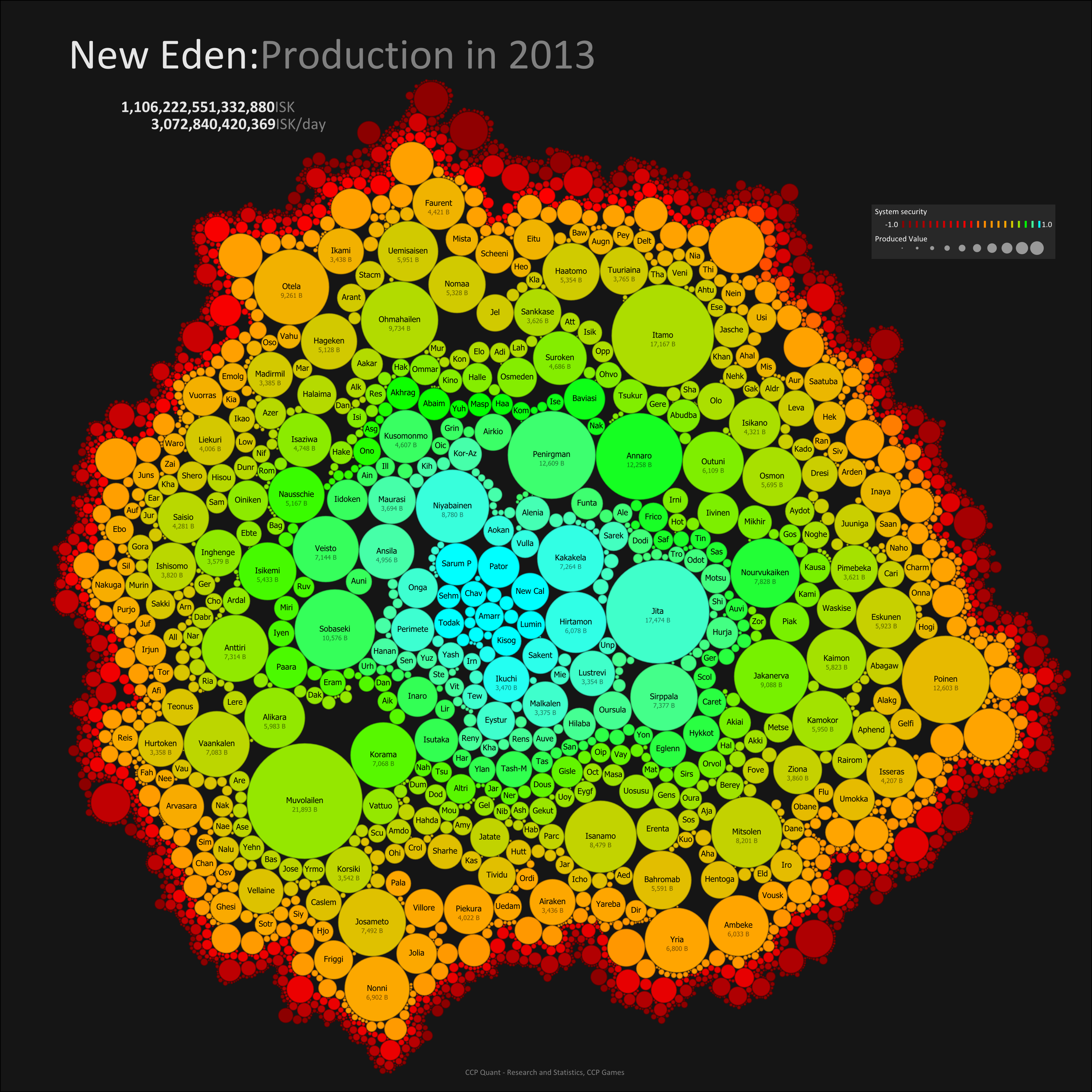
I feel confident that The Forge does the most industry in New Eden, due to the presence of Jita.  Remember the dev blog posting Insights into 2013 Production and Destruction.  See the picture, and notice all the tiny circles that are blue and green.  There are more of them than there are large or even medium blue and green circles.
Production.  

There are currently a lot of empty slots out there; probably more empty ones than filled.  Enough for everyone, especially after a substantial amount of the competition moves to POSes or to null.

So, don't panic manufacturers.  There will be plenty of room for profit.  What we are seeing here is not the evil Nullsec Cartel taking your profit for themselves.  We are seeing a leveling of the playing field, so that manufacturing can be done in nullsec and reasonably compete with highsec.  You are losing your massive cost advantage, but you are not being made uncompetitive.

That said, there will be some manufacturers that will be better off moving to null, and some better off staying in highsec.  This will be a function of transportation cost.  Mynnna, though not doing much in his recent blog post to quench the alarm of his critics (here's my comment), did have some useful numbers there on the transportation costs faced by nullsec: "30k isotopes per round trip".  Isotopes cost between 700 and 1000 ISK right now, depending on type.  And CCP is going to increase fuel requirement for jumping by 50%.  So, using a lower end isotope price, we predict transport costs of about 30m ISK for a round trip for a jump freighter.  That is a few percent for anything but a very low value load.  (To be fair, we must factor in other costs: the capital cost of a jump freighter is one.  The effective cost of losses to gank is another.  Opportunity cost is also worth mentioning.  These are impossible to know.)  In any case, the point is that transport costs are significantly higher to and from nullsec than in highsec.  Also, there is a balance factor preventing too much industry from moving to null: fuel costs will rise with demand.  In highsec, you can autopilot a billion ISK in substantial safety with no fuel cost at all.

So, what we can see is that to the extent nullsec does have a cost advantage in manufacturing proper, industry should be done there first for the things with high value:volume, then decreasingly for things with lower value:volume.  The very largest yet low value things, for example T1 ship hulls, will be manufactured in highsec because of the transportation cost advantage.  Small, high value stuff, for example most T2 ship parts, will probably move to null.  Medium sized stuff will be where the breakeven point is, and might be done in both regions.

Thursday, March 20, 2014

Economics of the New Reprocessing

Check out the latest dev blog.  It seems that CCP is going to substantially overhaul the reprocessing system (both ore and stuff).  ("Reprocessing" == "refining".  The latter word will be retired.)

The gist of it is that reprocessing will top out at much less than 100%.  For ore and ice, at a 50% efficient station, the max will be 72.4% with perfect skills and a 4% implant.  To compensate for this, they are going to increase the refining yield of all ores by 38.1% (1/0.724).  This keeps the value of mining essentially constant.

(Update: this is wrong.  Thanks, Gev.)  There is no mention of increasing all ore stocks by 38%.  So I infer they won't do that.  Which means something interesting: all ore held on patch day will suddenly be reprocessable for 38% more minerals than the day before.  Ore holders get a nice windfall.  Thus, we can expect the market for ore to go up, starting, well, now.  Or even before now, depending on how much the news has leaked.  But a quick look at tritanium at Eve Markets does not show anything.  A profit opportunity.  (Of course, the "interest rate" for holding ore is not going to be huge.  Still, anything is better than what one currently gets, namely, zero.)

Meanwhile, I expect a lot of manufacturing to be put on hold.  Consider the situation of a miner: if you simply hold on to ore for ~2 months (or whatever), you get 38% more for it.  So, why refine/sell now?  Many will sell to fund this or that, but many others will be happy to bank their ore.  This means minerals will go up, and indeed the entire manufacturing chain down stream.  However, these other things won't go up as much, because come patch day, they are not magically worth 38% more.  Thus, in effect, manufacturing is squeezed.  You can still make good profit, probably, if you are fast about selling.

Scrap reprocessing is going to be heavily nerfed.  The maximum efficiency will drop from 100% to 55% (maybe a bit more with an implant; not clear).  This means that a bunch of low-meta items will drop to about half their current price, since much of their demand is tied to mineral prices via reprocessing.

There will also be interesting effects on other markets.  In particular, scrapping is a vital means for getting minerals out to null.  This change will in effect abolish that practice overnight.  As such, anything built in null will be much more laborious (more jump-freighter runs), or perhaps locally sourced.

There are two interesting changes for wspace (and null) dwellers.  First, POS refining will be de-nerfed from far, far worse than a station (max yield of 75% and takes four hours), to be slightly better.  An intensive refining array will get a base rate of 54% to reprocessing yield, as versus the 50% at a station.  An outpost will be able to get up 60%!  And it will take 10 seconds.  (The current situation is insane.)  So, good for CCP!  I was planning to leave mining entirely, but now I am not so sure.  

Second, the medium refinery will go away to be replaced with a compressor (acts like a Rorqual).   I am not sure whether we'd use that or not; it depends on whether compressed ores are allowed into ore bays.  

Thursday, January 16, 2014

EVE Will Grow

The latest blog banter is about the subscription numbers for EVE.
... take a look at the All Time (weekly average) graph for concurrent accounts logged in.
For the past four and a half years, the graph has hovered around that 30,000 mark; it is, for all intents and purposes, a plateau. But everything must come to an end sooner or later and that is what this blog banter is about.
What's on the other side of that plateau?
Is there any path for CCP to follow to raise those numbers upwards for a sustained period, or is EVE going to enter a decline to lower logged in numbers from this point? How soon will we see an end to this plateau? Months? Years? Or will you argue that 'never' is a possibility? Or you can look at the root causes of the plateau and tackle the question if it could have been avoided or shortened if CCP had taken different actions in the past.
Also, what would EVE be like with an order of magnitude fewer or more players?
I've read some people's responses and was a bit surprised.  People are saying EVE may die or become a niche.  But I think the numbers will go up.

The hardware required to play EVE is not ubiquitous.  It is not even close, even in the developed world.  Data at la Wik: List of countries by number of broadband Internet subscriptions.  Look at the rates for fixed broadband.  I don't know if one can play EVE tolerably with the minimum "broadband" they have defined, which is DSL (256 kbit/s).  I doubt it.  But even allowing that EVE via DSL is possible, we still see broadband penetration rates in the first world of 27%.  A quarter.  And in the third world, nearly negligible rates around 5% or so.  If my doubts are correct, then in fact the number of people who can play EVE is an even smaller fraction of the population.

Another thing that makes EVE much better is a large monitor, and indeed, preferably two or more.  You need screen real estate to put all the spreadsheets on.  And you need two monitors to dual-box, which (due to the nature of many tasks in EVE) makes EVE a much more immersive and thus fun game.  Big displays have gotten radically cheaper in the last few years, and therefore must be becoming more widespread.  Most video cards can run two monitors these days.

Now, of course the sort of geek who likes EVE is far more likely than average to have broadband and a large dual monitor setup.  Why, everyone I know has broadband!  But still, there are a lot of people out there who cannot play EVE for the simple reason that they lack the connection to do so.  The vast majority of people who would love EVE if they could play it, cannot.  As true highspeed Internet continues to expand, the pool of potential players will increase tremendously.  Ditto for cheap large screens.  EVE will expand with these technologies.  Or at least, EVE should.  This is, I think, what one sees at in the first half of the graph above: a game that is expanding keeping a more-or-less constant share of highspeed Internet users.  So, the second half is not really a plateau; it is a decline.

One explanation for the decline may be the shift from desktop computers to mobile computers.  Personally, I feel this is a temporary thing; there are certain applications that simply require a lot of screen real estate.  You cannot effectively use a spreadsheet on an iPhone.  Be that as it may, over the past few years there has been a pretty sharp decline in the number of desktops sold, because mobile computers can do most of the most useful things that people use computers for.  And it appears the forecast for desktop sales is down for years to come.  So, this may be part of EVE's problem.  I don't think it is fixable; EVE on a cellphone is not viable.

A second explanation for the decline is the recession.  Here is another graph of basically the same information, which has proper axis labeling:

The plateau you can see correlates with some lag with the recession, which "began in December 2007 and took a particularly sharp downward turn in September 2008".  EVE's players seem to lag the recession a bit, perhaps a year.  But wealthy as they are in world terms, they are also being pinched.  EVE is a premium game; it requires a fairly substantial amount of money to stay subscribed for the average player.  The average player does not PLEX.  He just pays his $15/month.  Over a year that is $180 -- perhaps too much for many people when they lose their job.  (I also note that part of the reason for the decline of the desktop is the recession.)

So what are the prospects for EVE?  I see the plateau, or relative decline, as largely caused by market forces.  Those same forces will bring new players to EVE, eventually.

EVE is not going to stagnate forever.  Its appeal has evidently declined in the last few years, but it still has appeal; and I cannot see that it will lose that appeal.  You know that appeal, and I know it.  So, as more and more of the world population come online not just via cell phones, but via highspeed connections with big screens, EVE will grow again.  If and when the world comes out of recession, we will see growth.

"The" path that CCP needs to follow, then, is simply to keep doing what they are doing.  Potential customers are coming online all the time.  Their woes of recent are not their fault; their product is solid.  In fact, I think they should be a little proud of holding on to as much of their customer base as they have, given the recession.  We might compare them to the makers of other entertainment during the recession.  How is movie income?   Plateau.

Tuesday, December 10, 2013

I Steal from a Siphon

I've been out ghostbusting a lot recently.  When I do, I don't always dscan systems I enter.  But sometimes I do.  I almost always do a dscan in the system our wormhole comes down in, as well as searching it down.  Partly that is because I am in my exploration Buzzard.  Partly it is because I like doing small amounts of exploration, even though I have been doing more ghostbusting.

slurp
The other day I found the first siphon I have seen.  This was in Mafra, in Amarr lowsec.  There was nobody in local, so I knew I could check it out safely.  Still, there might be POS guns.  So I cautiously flew to thing at 10 km, just in case.  In fast the POS had no guns at all, just a bunch of hardeners.  So I gleefully grabbed a full Buzzard-load of moo goo.  (This did not get all of it.)  Then I headed back in to wspace.

Returning in my ghostbusting Tengu, I grabbed the rest of what the thing had stolen.  Then I went on my way, said Hi to Sugar, and eventually out into null for serious ghostbusting.  Eventually it was getting late and I returned.  There were people in system, but I threw caution to the winds and warped straight to the siphon.  One of them was there -- in a rookie ship.  I uncloaked and started locking, but this was not fast enough.  He warped.  Then I stole one more small portion of moon goo and headed back into wspace.

That's my complete story of interacting with siphons.  I have looked on many dscans in nullsec and never seen one.  As well as many other scans in lowsec.  Since I cannot stick to any given bit of kspace for long, I cannot really deploy them effectively myself.  But I can see what others are doing.  And on that count, I have to say that much of the debate before Rubicon on them seems to have missed the point.  They are not economical in most situations.  And people just don't want to grief when it does not cause tangible grief.  So they are not being used much.

Wednesday, December 4, 2013

The Fundaments of EVE's Design

I was thinking about doing a post about RMT in EVE.  But I realized that to really analyze it requires an understanding of the game's design.  You have to understand why the game is so compelling to discuss how to improve it -- or not.

Why is EVE so compelling?  On the surface, one can point to things like internet spaceships -- duh! -- and the glorious vistas one can see. (Check out Into the Ether, link found on the right, to see some nice pictures.  Reading that blog helps me to recall some of the wonder I had when I was newer, and that I still have from time to time when I step back from the spreadsheet and actually look at things.)

But the visuals are not the heart of the game.  We all know this because we spend most of our play time zoomed out, barely seeing anything more than some boxes and crosses in the midst of the spreadsheets.  And ditto for the spaceships.  No doubt their appearance adds a lot to the game, but many other games have had pretty spaceships.

One thing EVE gets right is production.  I love making things in every game I have ever played.  Many games have little you can make; others a fair amount.  But inevitably, crafting becomes dull because it is either a grinding activity, or because it is pointless, or because there is no market and your needs are very finite.  Making your first +4 sword is a rush.  But after you have one +4 sword, or maybe two, you don't need any more.  And then there's really no point in making more.

EVE takes crafting to a higher level.  How does it do it?  The immediate reason is the market.  You may not need another +4 sword, but someone else does, and you can sell it to him.  So you might make swords even if you don't need them.  But why would he need a sword?  We have generalized the question from one player to all players collectively, but not answered it.  We must look deeper.

The reason there is any substantial trading in EVE's markets is that in EVE there is consumption.  People require constant supplies of ships, fittings, implants, POS parts, etc.  Some fraction of this demand is coming from new players entering the game, but only a modest amount.  The real reason is that the existing stock of all goods is being constantly reduced.  EVE is full of destruction.

Ships and their fittings are blown up all the time in EVE, and the only way in which new ones appear is that someone, somewhere in the game, builds them.  (Well, almost only.  A tiny fraction of goods are created via gifts and missions, but nowhere near enough to supply the game.)  Similarly implants are lost in pods, POSes themselves are blown up, etc.  In highsec only, it is possible to have a "buy once, use forever" ship.  But nowhere else in the game, and even in highsec it is possible (if unlikely) to be ganked even when the gank is uneconomical.

One aspect of destruction that is obvious to EVE players, but should be mentioned here in case others are reading, is permanent loss.  In EVE, when something is blown up, it is gone.  It never respawns.  You will not be given more.  And the server is never reset.  The only way to replace a  lost object is to build another new one, or to buy it on the market from someone else who built it.

So, EVE "works" for the producer because of its destruction.  Loss means consumption, which requires production.

Of course, not all players are interested in crafting.  Some love it.  Some hate it.  To most it is a modestly interesting grind.  What do most players play EVE for?  PVP.  Let's now consider that.

Certainly EVE's PVP is compelling, but why?  When we experience it, we know why: because it gives us the rush of adrenaline.  We are "amped up"; we have to pee, we feel cold, our hands shake.  In victory, our brains flood with serotonin and we feel awesome.  In defeat, we log out and try to forget it, feeling crushed.  But why do we feel these things?  Why do we care?

The proximate reason we care is that we just stuffed a real live person out there (or were stuffed by).  An actual victim is required.  I have lost a handful ships to EVE's PVE.  It is embarrassing, and even gets a little adrenaline going the first few times, but it fades rapidly.  You know that it did not mean much.  You will use a better fit tomorrow, with better skills, and never lose a ship that way again.  And nobody is crowing over the loss.

We care about victory and defeat only when they are against real people.  But why?  Here the trail ends.  We care because we evolved to care.  We are evolved apes, and beating a rival in physical combat meant good things to our ancestors' genes, whereas being beaten was potentially deadly.  EVE allows us, risk-free, to stimulate the ancient reward and punishment circuits in our brains.

But the gaining of dominance or or being forced into submission is not all of the story.  I have played many games online, involving killing an enemy's units, or being killed.  And though it is certainly fun killing the enemy's units, and vexing to lose mine, few games have had the sheer intensity of the gain or loss that I find in EVE.  Why is that?

I submit that we care because we value our ships and pods.   We value them in our real life, not just operationally within the game context.  And we value them because they were expensive; because they actually cost us something real and substantial.  We got them by farming/grinding in the game, or via real money (injected as PLEX).  A loss is more than just a repositioning; it means dollars or hours of your life, and those are precious.  No game that respawns your character without serious loss, or which gives you stuff just for starting a scenario, can approach the emotional impact that EVE has.

It is that value that connects the PVP game in EVE to the production game.  The value created is the value destroyed.  Just as the concept of good necessarily requires evil, the elation of victory requires the relative boredom of farming.

Permanent gain and permanent loss, tied together.  Yin and yang.  This is what makes EVE great.  Every ship you lose means time grinding.  And that gives it real value to you.  Conversely, without ships constantly dying there is no point in making ships, meaning no point in the economy, no point in crafting.

There are a lot of other good aspects of EVE's design.  (The skill system, for example, is a clever design.)  But the creation of elating victory is the most fundamental.  And also, it seems to me, the most obvious.  And yet, I know of no other game that combines EVE's three key elements:
  • permanant gain and loss
  • player run market
  • PVP
PLEX are not part of this design per se; EVE existed and was addicting people long before PLEX were introduced.  But PLEX interact strongly with the system in interesting ways.  That (and RMT) is the subject for another post.

Monday, November 25, 2013

Economics of C4 PVE

Last night my corp had an ideal system for running sites.  It was a connected C4 system packed with anoms, many of which are the best type, and totally zipped up.  We exploited it to the max.  So, how much does it pay, running C4 sites?

We have found that a typical C4 anom will earn about 100m ISK in salvage and blue loot.  There is a lot of variance, because about half of the value is the salvage and it has a strong element of chance.  There is really only one salvage part that is worth much: melted nanoribbons.  If you get lucky on melted nanoribbons, you get more than average.  C4 radar and data sites are considerably harder sites, and they earn more.  Perhaps 120m average in blue loot and salvage.  You can also get perhaps 60m from can-cracking in relic sites, which is worth doing.  The minigames for C4 data/relic sites are the hardest ones in the game, so their earning rate is not great without maximum skills.  Data site cans are not worth it, although with a cargo scanner you can probably select only the relatively high value cans and earn a decent rate on a few cans.

Last night we completed 13 combat anoms, and another 2 radar sites.  So we would expect to earn about 1.5 billion, and we did.

How long did this take?  We started right at 8:00 with three of us.  Hiljah joined about 9:15.  We ended some time around 11:30; perhaps 11:15.

Using 11:30 for a conservative estimate, three of us spent 3.5 hours each.  Hiljah, 2.25 hours.  Four players; what did we earn per player?  We earned about 117m per man-hour.  What did we get per-character?  We used nine characters: two logis, one salvager, one fleet booster, and five DPS.  Thus,we earned 52m per character-hour.

There was some inefficiency in our setup.  Our salvager was not busy 100% of the time.  Adding DPS would increase his rate of earning a bit by keeping him busy more of the time.  And of course the logistics have very little DPS.  So, by adding a few more DPS characters we might get a moderate improvement.  (In fact we left one radar site untouched for lack of time.)

Wednesday, November 13, 2013

How to Make ISK from Highsec POCOs

Gevlon has a business idea for making money using highsec POCOs after Rubicon drops.  Since I did a lot of thinking about it to criticize him, I figured I would amalgamate my comments into a post.  For background, go read (or review) my Highsec POCO Predictions for Rubicon.  I'll wait.

Gevlon's Idea Will Fail

OK.  Gevlon's idea is to form an alliance specifically to raise wardec costs.
The alliance is just a price cartel agreement. Anyone can join... By joining you have to set the tax rate the same as everyone. ... You can't wardec a player owned corp if it's in an alliance, just the alliance itself. Such act has high cost if the alliance is huge, protecting the alliance from wardecs for their customs offices. 
But not for mutual defense:
What about PvP-ers, who wardec the alliance not because they want POCOs, but to get fights? Well, they won't get any. The in-alliance corps never fight.  ... So for their max-cost wardec they get nothing but the opportunity to shoot customs offices. How can you defend your customs offices? If anyone wardecs the alliance, it makes the war available for mercenaries, so you can just join with your shooter corp and defend your POCO.
This, as I told him, is a bad idea.  You must defend your POCOs or there is very little reason for the alliance.  This is because of the relatively high value of POCOs relative to the cost of wardec.  I pointed this out two weeks ago in my Predictions:
I have seen people say the wardec cost would have a big effect, and initially I agreed with them.  It seems plausible that a 10x cost difference for war would matter a lot.  But after thinking about it, I feel it will affect only small corporations.  
Consider a medium sized corp with 25 pilots.   In a battleship, each pilot can do about 1000 DPS.  POCOs have 10m shields and reinforce at 25% shields.  Thus this corp can hammer one into reinforced in just five minutes.  Killing a POCO after reinforcement is easier.  They have 250k armor and 200k structure.  So it would be very fast.  In a week of war, and unopposed, a corp could reinforce or destroy 20 POCOs a day.  Since POCOs cost about 100m ISK, the cost of the wardec is a small percentage of the capital at stake.  The cost of the fleet is much more than the POCOs it destroys.
And note that Gevlon's alliance actually make things easier for an aggressor.  It's a one-stop shop for targets.  Say that Gevlon has gotten 50 corps to join, each with 20 POCOs.  Now you go to all of them and demand they hand over their POCOs to you for half their value, or war.  Each one individually cannot afford to hire Noir.  Collectively they could, but they have no organization.  Perhaps they all stand firm and hope that the aggressor attacks someone else.  So he wardecs anyway, and attacks all of them.  After they each lose a POCO or two, they'll sell the others.

How to Do It Right

Gevlon's idea of an alliance is a good one.  But it cannot be passive as he wants.  A passive alliance is easy to beat.

The alliance should offer substantial services to its members.  It should have its own fighting fleet (more on that in a bit), and make a standing offer to members to buy their POCOs at 80% of par.  It also insures their POCOs at 50% of par: if a member loses a POCO, you pay out half the value.  This gives the incentive to the alliance to defend, and some insurance to the members that you will, while not giving too much of a free ride.

Of course, getting a decent fleet able to fight and win will take a substantial amount of time.  There is no such time before November 19.  Yet the first-mover advantage will be huge.  How do you deal with that?  You retain the mercs necessary to defend all the members' POCOs. Find the best mercs you can -- Noir? multiple groups? -- and get a long term contract with them, six months at least, saying (1) that they won't wardec your alliance for any client, and (2) that they will be available to fight for you on call (other obligations permitting). Perhaps this is a billion per month. Who knows: ask them. It might be quite reasonable.

How do you pay for hired guns?  You charge a fee per POCO, perhaps 10 million ISK per month. (This is about 10% of its build cost; I should think that is cheap for decent protection.)  Charge more for rarer planet types (i.e. storm), or those in better locations (i.e. near Jita).  (What exactly to charge is a hard problem, but that's why you need a leader with spreadsheet chops.  I am sure Gevlon can figure out a good price structure.)  If 10m a month sustainable?  I think so; recall the analysis Mabrick did.  A single user of a POCO can generate that much in taxes.  If the POCO has more than a handful of users, the owner still makes good money.

With my guess of the merc's retainer fee of 1b per month, once you get 100 POCOs, you make money. If you cannot get 100 POCOs, you lose money. If the mercs you hire cannot beat some larger group and it kills your POCOs, you lose a lot of money. If you welp fleets, you lose a lot of money.  It will take a very deep pocket investor.  It will have substantial risk.

Note that hiring mercs as the primary defenders is only really applicable during the bootstrapping phase of the existence of the alliance cartel.  As soon as possible, you will want to start insourcing your protection, with mercs hired only in exceptional hard situations.  Find a good fleet commander, and hire him to organize a navy for you.  Men will flock to fight under a good FC.  Remember the lesson of nullsec: players in a game don't care about money so much as they care about "content".  If you offer them fun they'll pay you for it.  Fighting in massive battleship fleets should be fun.  I would join.

Why do you need your own fleet?  In part the reason is that relying on mercenaries is bad idea -- they may be working for the other side; they may turn on you; or they may just not be available due to other obligations.  But it is also because insourcing should be cheaper.  Noir has elite pilots that can fight anywhere in all types of situations; you need only be concerned with ships and tactics that are allowed in highsec.  Also, Noir's pilots have no reason to care about the POCO business.  And you should be under almost constant wardec as the biggest, fattest target around, and you will need a very substantial fleet to defend yourself.  (My guess is hundreds of pilots.)  If it takes raising POCO fees to support your fleet, so be it.  Any owner who does not like the fees is perfectly free to leave the alliance and defend his assets on his own.

A fleet can also aggress.  Most of the time it will probably be busily defending, but what if you get a slack week?  The alliance should be the aggressor, demanding that lesser corps join or lose their POCOs.  Forming a monopoly where there is no natural monopoly is not like normal market competition: it takes force.

Wednesday, November 6, 2013

Pondering Rubicon's New Auto Tractor Units

With Rubicon will come a new deployable structure, the automatic tractoring unit.  I don't know exactly what it will be called.  How will it affect the game?

Here is what I can find out so far about the auto tractor unit.  You can read it yourself in the thread where Fozzie announces them; these are taken from his posts:
  • 100m3 volume.
  • When deployed has storage of 27000m3 (just slightly less than a jetcan).  Cannot be deployed closer to 5km from other deployables.
  • 125km tractor range.
  • Can tractor one target at a time.  Checks for targets every 10 seconds.  Will tractor anything that the game would allow the owner to tractor.  It keeps tractoring all day long even when full.
  • You can scoop and reuse it. If you scoop it while it has items in the cargo, it will spawn a jetcan with those items which you can then loot what you'd like from.
  • Tractor speed is 1000m/s.  [Note: 2 minute tractor time at max range!  Ouch.]
  • Rats won't target it.
  • Has an automatic activation time [apparently its "onlining" time], currently set to 45 seconds.
  • Only the owner can take from it.
  • Can be probed and is visible on d-scan.  Easy to probe.
  • It can be destroyed.  Hitpoints in the range of 80000 or so.  Drops loot just like a ship, 50% chance of each stack dropping.
  • Shooting one in highsec gets you a suspect flag but no Concord.
  • It has the same kind of decay timer that anchored cans do, where if you interact with the cargo often it never goes away but if left alone it disappears after 2 days.
As of now, on singularity there are bugs.  Or odd features.  From this thread:
  • It does not work when nobody is on grid.  CCP says this will be fixed.
  • Targets your ship, or other ships (including cloakies).  CCP stays this will be fixed.
  • Two of them within range of each other "see" each other's wrecks and play ping-pong.
Assuming the two problems they say will be fixed are fixed, so that the thing is useful, I can see a lot of application for it.  Basically, anyone who is salvaging any substantial wreck field currently will probably do better to pack one of these (or more, assuming they fix the ping-pong feature).  Deploy it ASAP and let it tractor while you salvage.  It's like an extra tractor with super-long range.  If you currently use a Noctis with 4/4, go to 3/5 and go faster.  Or deploy more than one as close to each other as possible, and sit between going even faster.

Of course, if you can tractor a wreck, then you probably created it.  Since rats don't shoot at tractor units, and you can fit five of them confortably in your missioning battleship, the time to deploy it is not when you come back to salvage.  It's when you first land on grid.  (Or maybe after you initially move.)  So, deploy the unit as soon as you land on grid.  Bookmark it.  Kill all the things, then do the next room.  Come back in a few minutes and all your loot is collected, and all the wrecks in nice little ball.

It will also benefit mission-runners who currently do not salvage/loot.  So long as you are in a room sitting still for more than 45 seconds, it can get you at least a little loot, and a little is better than zero.  And possibly salvage too, if you have room for a flight of salvaging drones.

Salvaging will change radically.  No longer does a salvager ship need to combine salvagers and tractors.  It just needs salvagers.  Noctises may still be useful in a more limited way.  But I would expect to see a much larger set of ships being used to salvage, depending on the risk level.  Noctises will still rule highsec, I expect.  But not insecure space.

In wspace, this unit will obsolete the Noctis.  Tractoring and salvaging will be concurrent with combat.  Fleet warps in, immediately deploys 2-4 tractor units.  PVE as normal.  Wrecks are being sucked in as fast as they are created.  Salvager ship with the fleet salvages the wrecks.  Fleet has to wait a few extra seconds at the end of combat before warping, to guard the salvager.  Or else, maybe the fleet just warps and the salvager takes its chances.  But note that the salvager is not going to be a Noctis.  It does not need tractor range; the tractor units provide that.  It will be a hardened ship, probably a "combat" hull, perhaps stabbed up, with some salvagers in the highs.  Since it can salvage throughout combat it does not even need that many salvagers.

My corp is still discussing what we will do.  Partly it depends on details we don't know yet.  But I think the broad outline is present.  Currently, our salvager (a Noctis) trails the fleet; to maintain operation security we zip up, or we use observers on all the exits.  In Rubicon, the salvager will be a Raven, Scorpion or some other battleship.  (This gives it the option to mount a Micro Jump Drive for GTFO.)  The salvager will now move with the fleet.  We will deploy one or more tractors on grid, however many we need to gather all the wrecks in a timely manner.  The salvager will have enough salvagers to salvage all the things; this may be as few as two salvagers.  If say three or less, it can add DPS and will be used for that too.

Is it a conflict driver?  I do think it will make the life of a mission ninja more fun.  Imagine hanging around Osmon with combat probes, looking for these.  You pop into the mission with your ninja salvager destroyer and find a nice ball.  It's all there for you to salvage.  No driving around.  Then zip to the next room.  Do you blow up the thing for loot?  Maybe!  Missioners might get wise and start to watch for their auto tractors disappearing from dscan though.

How about null and wspace?  I am not as sanguine.  In both places hunters will certainly look for them.  And they might blow them up from time to time (certainly in wspace).  Whether this will be opposed seems less likely.  Meanwhile, at least in wspace they will kill one of the ganking types that keeps people on their toes: the Noctis salvager gank.

What will the economic effects be?  If I could short tech I salvage, I would.  And similarly for anything else that comes out of normal highsec mission grinding and nullsec anom smashing.  Meta 1-4 parts. 

Tuesday, October 29, 2013

The Official VK Attitude About Somer Blink

I gotta ditch that zombie and put Stabs on the blogroll instead.  He's got another good read over there at Stabbed Up titled The Somer of Revolution: 4000 headless chickens can't be wrong:

because I like Eve that I don't wish to see the Eve dominated by this petulant "oh he got something I didn't" whining that the community is so addicted to.
It's destructive.
Whining about the monocle led to a crisis at CCP that saw 200 people laid off. Many companies fail to survive such turmoil, we're lucky we still have Eve after that. And why? Because "he gets to wear a monocle and I don't get one waa waa waa."
If you jumped on that bandwagon shame on you, you idiots almost killed CCP.
Fast forward to Scorpiongate. Some PR dude at CCP gave out some freebies. "Oh waa waa waa, I didn't get one, shoot the monument."
Sheeez. Big babies.
Now on to the latest controversy. Turns out that through a convoluted chain of kickbacks people who route trafffic to GTC sellers as affiliates can leverage Eve assets into real money. "Oh waa waa waa, I'm not getting any."
How about you get off your butt and inject some value into the sandbox?

Just so.  Look, there's a difference between me and Somer Blink.  Somer earns hundreds of billions of ISK parting fool willing players from their money, creates massive content (gambling) for CCP, and moves a lot of time codes.  And yeah, they RMT.  So what?  You know who else RMTs?  CCP.  You know: PLEX?  If CCP wishes to share a piece of their RMT monopoly with Somer, that's no business of mine.  At worst I might criticize it as a bad business decision, but you know what?  I don't think it is.  I think allowing a certain level of RMT is good for a game.

Parenthetically: what people need here is an understanding of why RMT is bad.  I am sure you have a theory.  But unless your theory can explain why PLEX are good, while other RMTing is bad, then it is not subtle enough to give any useful information on how to evaluate Somer's crypto-RMTing.  Perhaps you might think on that.

This whole situation could be resolved very easily by CCP.  They should announce as follows: Nothing has changed.  RMTing is still disallowed by EULA.  However, we are making a new "special top timecode partners" program that allows RMTing within parameters we set.  There is currently one STTP: Somer Blink.   If you move a million timecodes, you can join the program.  Now, stop your bitching and shut up, whiners.  HTFU.